Based on the root causes, possible countermeasures for solving the problem are generated. A prioritization between the different countermeasures will take place to select the most viable ones.
Tools and tips
Defining countermeasures can be done in three steps:
1. Propose countermeasures; Use a small brainstorming session to list initiatives and improvement actions to solve root causes. Brainstorming is an idea generating process in which you involve different colleagues to find possible solutions. The objective is to generate as much ideas as possible and stimulate creative thinking. Remember, in this stage all ideas are good, don't criticise but find ways to build upon ideas from someone else.
Tip: describe your countermeasures concrete. It should be clear what exactly needs to be changed. Avoid vague countermeasures like 'improve communication', 'provide clear instructions' or 'take a more active role'. Make it more concrete instead. For example; 'create a PDCA template for the ships in which is stated what is expected from each step of the PDCA including tools they can use'.
2. Select best countermeasures; Select the counter-measure(s) by looking at the effort and impact of a counter-measure. From the extensive list of ideas you will now select the countermeasures that you will implement. The Impact x Effort matrix is an effective tool to facilitate this process. For each countermeasure you define how easy it is to implement (Effort) and to what extend it will solve the problem (Impact).
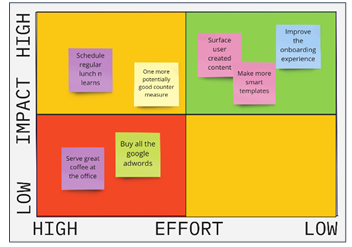
For example; countermeasures that can be implemented on board by the crew themselves are easy to implement (Low effort), while countermeasures that require new equipment or tools are much more difficult and require more time (High effort).
Select the countermeasures that have a low effort and a high impact. Challenge the team to select only 1-3 countermeasures and to select countermeasures that are in control of the team themselves.
3. Define the expected outcome; Define the expected outcome of your countermeasure by measuring (or guessing) what the impact of the countermeasure will be. By predicting the outcome/ result you analyse if you will be able to solve the problem by implementing the selected countermeasures. When the expectation is that the selected countermeasures will solve the problem, you can continue with the implementation. If not, select more countermeasures or consult the Superintendent or Fleet manager to decide on next steps.